
SaaS · Platform · AI · Brand · Web · Multi-lang
poitim.com
Global B2B team management platform, built end to end from brand identity to the desktop app, in five languages.
View live site ↗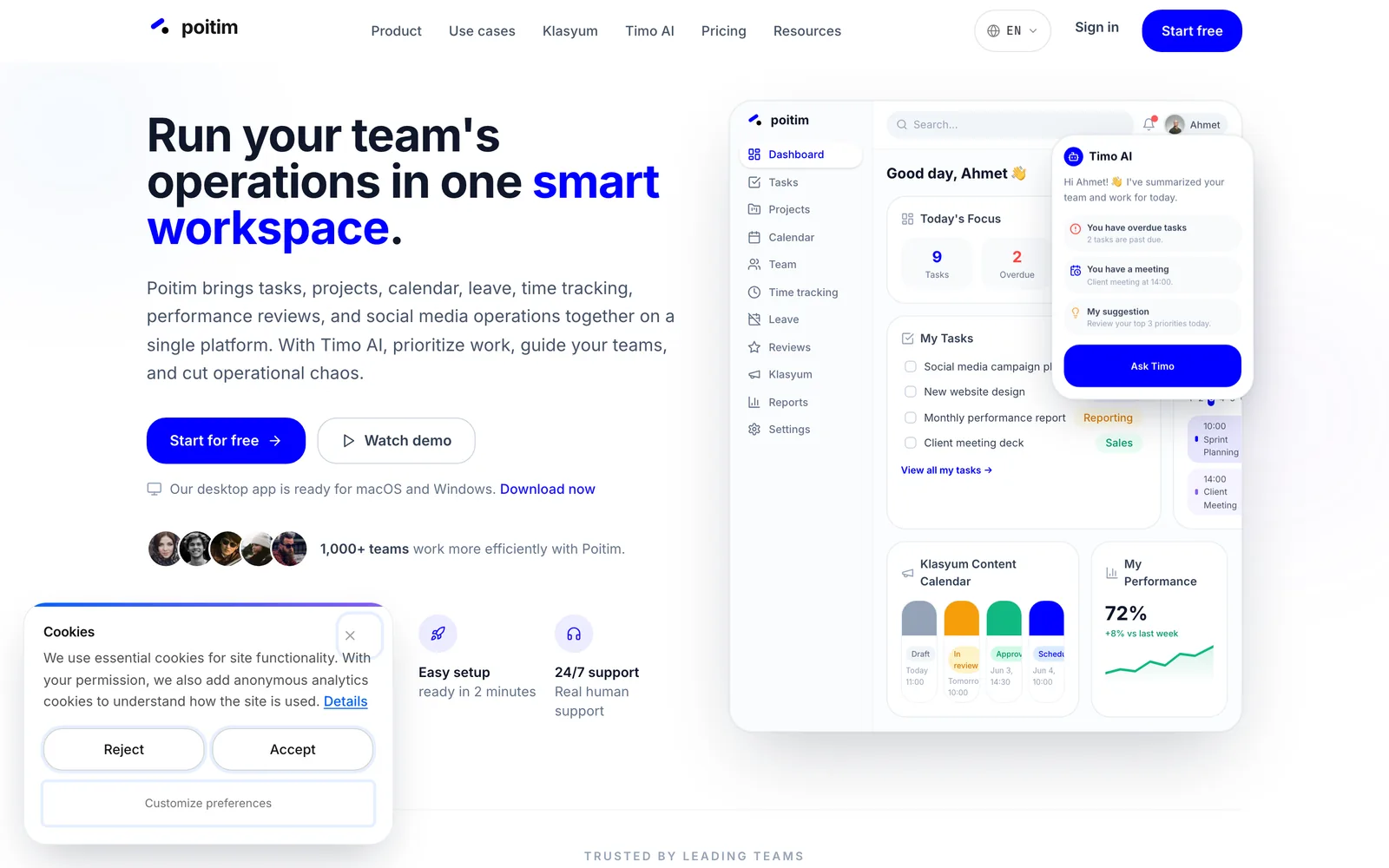
01 / Problem
A team's entire operation was scattered across separate tools: tasks in one place, leave requests in a spreadsheet, the shift rota in a chat thread, performance conversations nowhere at all. Lining up standard tools side by side does not fix that mess, it only moves it.
02 / Idea
One workspace: tasks, shifts, leave, performance, the content calendar and reporting, all on the same data model. A built-in AI assistant called Timo and Klasyum, the module that runs brand and content operations, took shape around this vision.
03 / Solution
Brand identity was built from zero first, then the product itself: a multi-tenant backend, a role and permission matrix, a web application and a self-updating desktop app for macOS and Windows. Tasks, projects, sprints, shifts, leave, timesheets and performance reviews, the Klasyum content calendar and Timo AI live under one roof, while ClickUp, Google Calendar and Telegram integrations connect outward.
04 / Result
poitim.com is live: a global B2B team-management platform publishing in five languages (TR/EN/ET/RU/AR, Arabic RTL included). Not a landing page but a complete product running on its own infrastructure, designed and built end to end by a single team, from the web app to the desktop client and web push notifications.
In depth
Context
POITIM is a B2B team-operations platform for small and mid-sized teams: tasks, projects, sprints, shifts, leave, timesheets, performance reviews, a content calendar and a built-in AI assistant, in one workspace. It is a global product published in five languages, designed and built end to end by POI369.
Challenge
Replace a scatter of tools with one data model without becoming another shallow all-in-one; isolate every tenant’s data strictly; give teams a desktop presence and notifications; make the AI assistant useful inside real work rather than a novelty; ship all of it in five languages including right-to-left Arabic.
Approach
Brand first, then product. A multi-tenant backend with a role and permission matrix sits under a web application and a self-updating desktop client for macOS and Windows. Timo, the assistant, works with tenant-scoped context so it answers about the team’s own tasks and calendar. Klasyum, the content-calendar module, runs brand and content operations on the same data. ClickUp, Google Calendar and Telegram integrations connect outward; web push keeps people informed without email.
What POI369 did
- Brand identity from zero: name, logo system, product visual language
- Multi-tenant backend, authentication with Google sign-in, role and permission matrix
- Web application and self-updating desktop client for macOS and Windows
- Modules: tasks, projects, sprints, shifts, leave, timesheets, performance reviews
- Timo AI assistant and the Klasyum content-calendar module
- Integrations with ClickUp, Google Calendar and Telegram; web push notifications
- Five-language interface with Arabic right-to-left support
- A dedicated security review in August 2026 that hardened tenant isolation across the API
Systems and capabilities
- Single-page web application with a Node.js API
- PostgreSQL with tenant-scoped data access
- Desktop client with automatic updates
- Large language model API behind the assistant, scoped per tenant
- Self-hosted infrastructure with monitoring and off-site backups
Outcome
POITIM is live as a complete product on its own infrastructure: web app, desktop client, assistant, integrations and notifications, in five languages. It is the reference project for our SaaS and AI-assistant work and the origin of several engineering patterns we reuse, including the tenant-isolation checks now applied to every API we build.
What we learned
- Tenant isolation has to be verified per endpoint, not assumed from the data model. A review found and closed gaps that unit tests had not exercised.
- Database drivers return large integers as strings; equality checks silently fail unless the boundary is explicit.
- An assistant is only useful when it can see the team’s real data safely. Scope the context first, then the prompts.
- A desktop client changes expectations: updates, notifications and offline states become product features.