
AI · Multi-lang · Platform
faltastik.com
AI-integrated fortune telling and astrology platform across 6 languages.
View live site ↗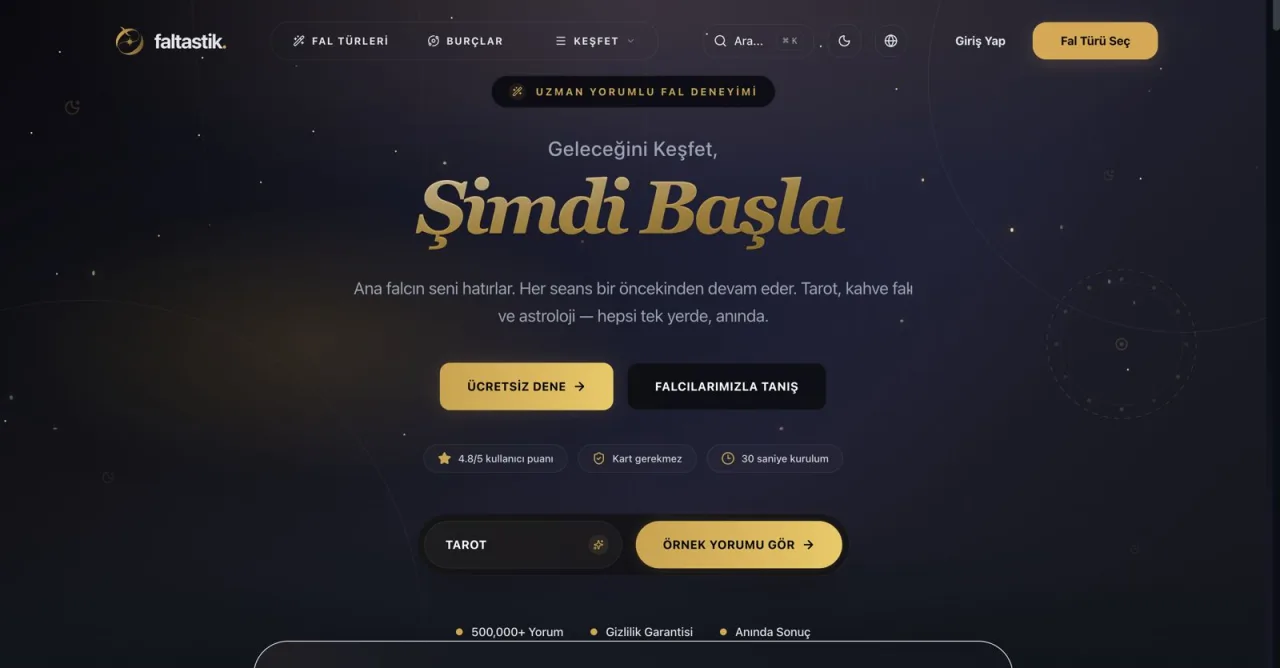
01 / Problem
No platform existed that could serve the divination and personal guidance space at global scale, spanning multiple cultural traditions in multiple languages.
02 / Idea
An AI-assisted platform covering 6 languages and 10 divination categories - from Turkish coffee reading to I-Ching, tarot to numerology - each with its own native content library.
03 / Solution
A 6-language international platform (TR/EN/ET/RU/AR/KU) was built. A 78-card tarot library, 500+ Turkish coffee symbols, and 700+ dream interpretations form the platform's content architecture. A freemium + token monetisation model was integrated.
04 / Result
faltastik.com is live: 6 languages, 10 categories, AI-assisted readings. Multilingual content architecture and freemium model running in production.
In depth
Context
Faltastik is a consumer platform for divination and personal guidance: tarot, Turkish coffee reading, astrology, dream interpretation, numerology, I-Ching and other traditions, published in six languages including right-to-left Arabic and Kurdish. POI369 designed, built and operates it as its own product.
Challenge
Serve several cultural traditions in several languages with consistent quality, make AI interpretation feel personal rather than generic, monetise without putting everything behind a paywall, keep a very large multilingual content catalogue indexable, and stay fast on the mobile devices most readings happen on.
Approach
Interpretation is grounded in curated libraries rather than free generation: each category has its own symbol and meaning library (a 78-card tarot set, more than 500 coffee symbols, more than 700 dream interpretations) that the model draws on, so answers stay consistent with the tradition. Readings keep persistent user context so later readings build on earlier ones. Monetisation is freemium plus a token wallet. Every locale has its own server-rendered pages and localised routes.
What POI369 did
- Brand identity, product design and the six-language content architecture
- The web application, user accounts, token wallet and payment flow
- The AI interpretation pipeline with curated libraries, guardrails and per-category prompts
- Daily horoscope generation running on a schedule for every sign and language
- The SEO and AI-search content layer: category pages, blog, structured data, sitemaps
- Migration of the data layer to a self-managed database with a typed query layer, and a security review of the public API surface
- Mobile performance work: the landing page JavaScript payload went from 533 KB to 296 KB in our own measurements
Systems and capabilities
- Next.js application with server rendering
- PostgreSQL with a typed query layer
- Self-hosted infrastructure with backups and monitoring
- Large language model APIs behind an interpretation service
- Card payments and a token ledger
- Multilingual routing with right-to-left support
Outcome
Faltastik is live in six languages with ten reading categories and AI-assisted readings in production. The freemium and token model operates, the multilingual catalogue is indexed, and the platform runs on infrastructure we manage. It is the reference project for our AI product and multilingual publishing work.
What we learned
- Language is an architecture decision: adding a locale must be a compile-time contract, not a content chore, or translations silently go missing.
- Third-party services support fewer locales than you do. A payment provider rejecting two of our six languages broke checkout for those users until we mapped locales explicitly.
- Curated libraries make AI output consistent and cheaper; free generation drifts.
- Rich content that is not bound to the pages that need it does nothing for search. Every SEO page must render the real data.