
SaaS · Platform · Web
POI CLOUD SYNC
No-code SaaS integration platform for SMEs: connects CRM, ERP, e-commerce and accounting tools with drag and drop.
View live site ↗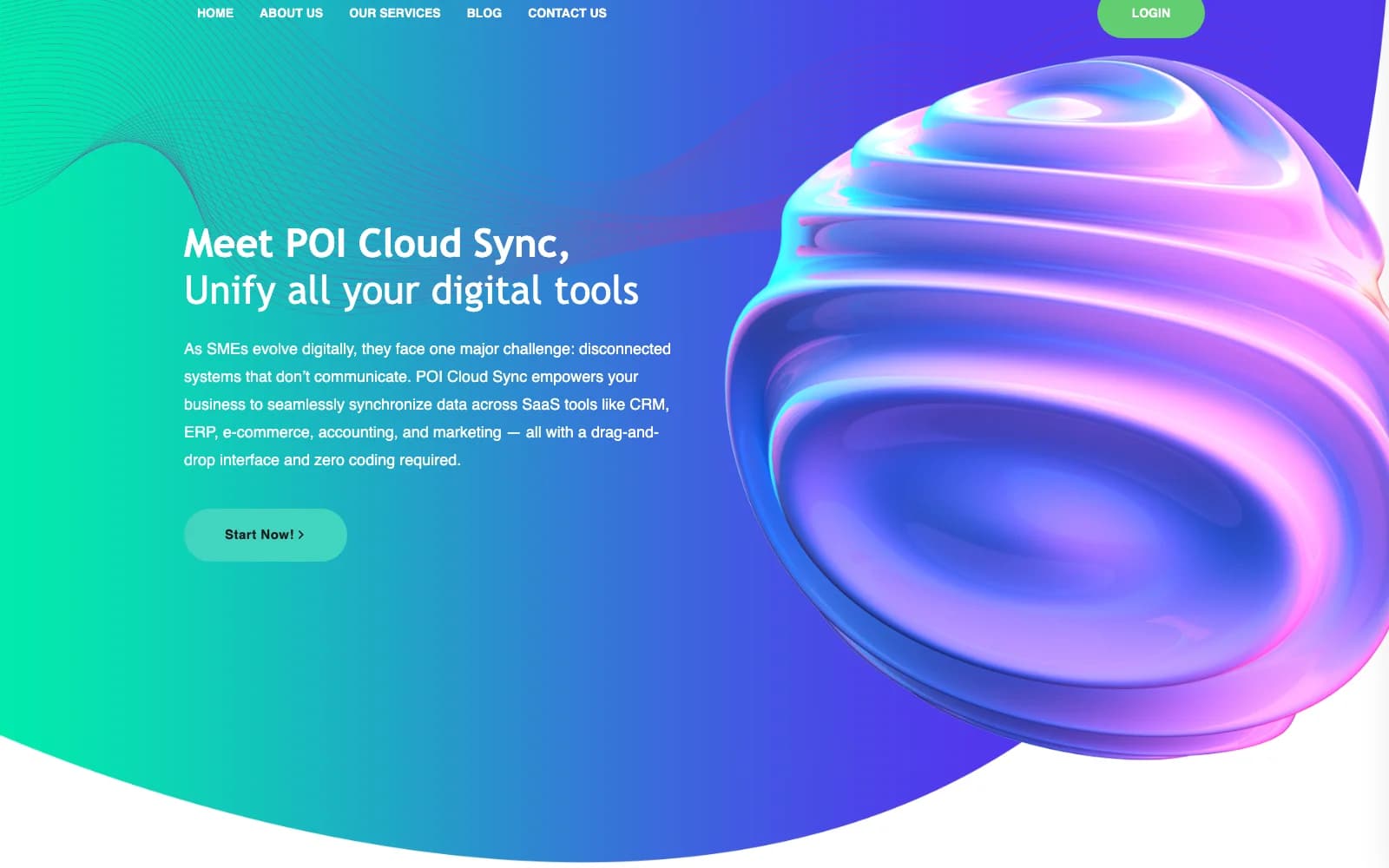
01 / Problem
SMEs run 20 to 30 different SaaS tools on average, and most of them do not talk to each other. The same data gets typed into three systems, transfers eat hours and reporting stays fragmented.
02 / Idea
A no-code integration layer: POI Cloud Sync, a SaaS platform that connects CRM, ERP, e-commerce, accounting and marketing tools through a drag-and-drop interface.
03 / Solution
Brand identity, product interface and marketing site were designed under one roof. Drag-and-drop integration building, real-time data flows and encrypted transfer form the core of the product.
04 / Result
poicloudsync.com is live: teams can build integrations without waiting for a developer and manage every data flow from a single panel.
In depth
Context
POI Cloud Sync is an integration platform that connects CRM, ERP, e-commerce, accounting and marketing tools without custom code: a visual flow builder, a catalogue of ready-made connectors, real-time monitoring and a data transformation engine. POI369 designed the brand, the product interface and the marketing site, and its founder is the platform’s chief architect.
Challenge
Small and mid-sized companies run dozens of SaaS tools that do not talk to each other, and integration work usually waits for a developer. The product had to let a non-developer build a reliable flow, keep running when a third-party API failed, and meet enterprise security expectations for data in transit.
Approach
A drag-and-drop flow builder over a large connector catalogue, with transformation steps between systems, encrypted transfer, and flows that detect failures and recover instead of silently stopping. Monitoring shows every data movement in one panel. AI-assisted classification and transformation are used where fixed rules are not enough.
What POI369 did
- Brand identity, product interface and marketing site under one visual system
- Flow builder interaction design and the connector catalogue structure
- Real-time monitoring and the self-recovering automation model
- Security posture for data in transit and access control
- The marketing site and its search architecture
Systems and capabilities
- Next.js product interface and marketing site
- Connector catalogue with more than 400 ready-made integrations
- Real-time synchronisation and monitoring
- Encrypted transfer and access control designed for enterprise requirements
Outcome
POI Cloud Sync is live: teams build integrations without waiting for a developer and manage every data flow from one panel. It is the automation backbone we reuse in client work, and the reference project for our business-process automation and AI-integration services.
What we learned
- Integration products are judged on failure handling, not on the happy path. Recovery and visibility are the product.
- A connector catalogue is a content architecture problem as much as an engineering one; naming and grouping decide whether people find the right connector.
- Rules first, models second: most transformations are deterministic, and AI belongs only where rules run out.